

The Majority of the U.S. Population is White
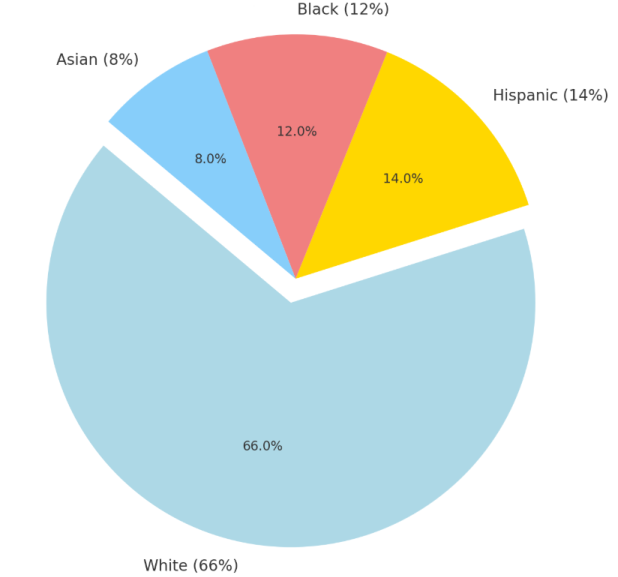
As of February 2024, according to The Wall Street Journal, the racial composition of the U.S. population is approximately 66% white, 14% Hispanic, 12% Black, and 8% Asian. Compared to whites, Hispanics and Blacks are considered minorities, while Asians make up an even smaller minority among them.
Relatively High Ivy League Admission Rates for Asian Students
Let’s take a look at the racial composition of students admitted to Ivy League universities, one of the top-tier university groups in the U.S. Whites constitute nearly half of the student body, making them the majority. However, Asians, who represent the second-largest group, account for nearly 20% of Ivy League students. This is a significant figure, considering their relatively low percentage of the overall U.S. population.
Below is a chart comparing the racial composition of the U.S. population to the admission rates of Ivy League universities. It is evident that Asian students are admitted to Ivy League schools at a disproportionately higher rate than their population ratio.


Why is Affirmative Action Necessary?
Affirmative action, a policy aimed at favoring underrepresented racial groups by lowering admission standards or implementing minimum quotas, is one of the most debated topics in the U.S. today. While it is currently practiced by many universities and organizations, it appears to be in a transitional phase.
Is affirmative action a policy to ensure fairness? At first glance, it might seem so, but the reality is far more complex. Misunderstandings about its purpose often lead to significant conflicts and controversies.
To evaluate its legitimacy or appropriateness, we need to first consider the purpose of the organization. For companies, the primary goal is profit; for universities, it is to provide quality education and nurture talent. While these are not the only purposes, it’s essential to note that racial diversity in itself is not inherently valuable. What matters is whether the pursuit of racial diversity contributes to the organization’s goals—whether it helps companies generate more revenue or universities deliver better education.
For example, if employing an entirely Hispanic workforce would result in maximum profits, companies would actively pursue this strategy. Currently, it seems some organizations embrace affirmative action partly to gain favorable public or governmental recognition. Anyway, this still ties back to profitability.
Racial Diversity Contributes to Higher Education Quality
Returning to universities, does racial diversity enhance the quality of education? The answer is "yes". Let’s define the standard for quality as ensuring that as many students as possible receive the highest quality education.
We should focus not only on the accumulation of knowledge but also on fostering critical thinking skills. Simply trying to cram a large amount of knowledge into one's mind is no longer as effective as it used to be. Critical thinking, or "open-minded thinking," arises from diverse experiences and knowledge. This is also why T-shaped skills—broad knowledge with deep expertise in one area—are often emphasized, Racial diversity inherently fosters such a diverse environment, encouraging students to think openly and critically.
Racial diversity plays a role in enhancing overall students' cognitive abilities, contributing to a higher quality of education. Therefore, affirmative action can be considered a practical policy, even if students with lower SAT scores may find it challenging to keep up with certain aspects of the coursework.
How Much Affirmative Action is Necessary?
The critical question is not whether to implement affirmative action, but to what extent. While I don’t claim to have a definitive answer, the key lies in finding the optimal balance.
Affirmative action primarily benefits underrepresented groups, particularly Black and Hispanic students, allowing them to apply to higher-ranked universities despite lower SAT scores. Conversely, Asian students often face stricter standards. While racial diversity and open-minded thinking are crucial, universities, especially Ivy League schools, still focus heavily on rigorous academics. Students admitted with lower SAT scores may struggle to keep up with the demanding coursework, potentially lowering their chances of becoming top-tier professionals after graduation.
This means affirmative action has both advantages and disadvantages. It elevates the overall quality of enrolled students by leveraging diversity but may also result in lower average performance among some admitted groups. Some might argue that the policy sacrifices lower-performing students to boost the potential of the overall student body. However, it’s worth noting that even students benefiting from affirmative action gain valuable opportunities. The true "victims" might be those who would have been admitted in the absence of such policies.
Ultimately, affirmative action policies have the advantage of leveraging diversity to enhance the overall quality of the student body. However, they also carry the drawback of potentially admitting students whose qualifications may fall below the average compared to their peers. In some ways, it might appear that these policies prioritize affirmative action beneficiaries while sacrificing lower-tier students to bolster the performance of mid-to-upper-tier students collectively.
That said, it’s important to note that students admitted under such policies are not disadvantaged; they too benefit significantly from these opportunities. If there are any true victims of affirmative action, they might be the students who could have been admitted in its absence.
(For example, after MIT abolished its affirmative action policy, Black and Hispanic enrollment decreased, while Asian enrollment increased.) https://bbc.com/news/articles/c8rxvd2z6ldo
MIT: US university says diversity slumps after affirmative action ban
MIT says intake of some minority groups has fallen from 25% to 16% in one year after a Supreme Court decision.
www.bbc.com
Conclusion
In summary, affirmative action policies should aim to maximize their effectiveness, much like the principles of supply and demand. The goal should be to converge on a point where the policy produces the greatest benefit—creating the most talented graduates while maintaining fairness and inclusivity. Striking the right balance is essential, as either excessive or insufficient implementation could be a disadvantage.